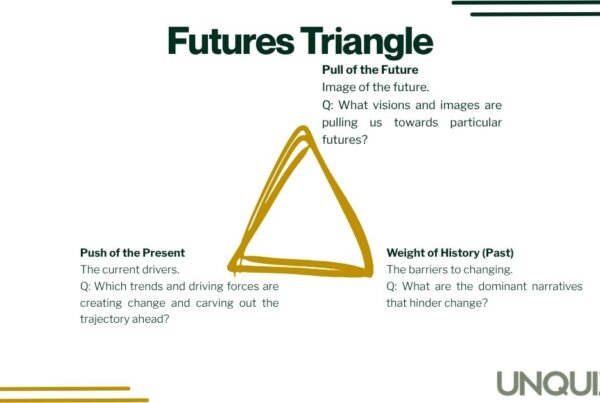

Organisations often talk about trends as if they are the future itself. In reality, trends are only the visible surface of deeper change, while drivers of change are the underlying forces shaping what becomes possible, likely, or disrupted over time. For organisations working in complex and community-facing environments, the difference matters. If we only track trends, we may notice what is changing. If we identify drivers, we begin to understand why change is happening and where it may lead.
Foresight offers a practical way to move from scanning to sensemaking. It is a structured and systematic approach to exploring plausible futures, rather than predicting a single outcome. This matters because many organisational decisions are still made using linear assumptions: that the future will resemble the past, only more so. Foresight challenges that habit by asking leaders to consider multiple futures, non-linear effects, and the possibility of disruption across social, economic, technological, environmental, and geopolitical domains.
Why trends are not enough?
Trend analysis is useful, but it can be misleading if used in isolation. A trend may show that something is growing or declining, yet it does not tell us whether that change is temporary, structural, or symptomatic of a broader shift. For example, an increase in digital engagement might reflect a short-term behaviour change, or it may point to a deeper driver such as generational preference, economic pressure, access inequality, or changes in trust and communication norms. Foresight encourages organisations to look beneath the surface and ask what is driving the pattern. This distinction helps organisations avoid overreacting to noise and underreacting to genuine change. It also supports better prioritisation. Not every trend deserves strategic attention. The real question is whether a trend connects to a driver that could reshape the organisation’s purpose, operations, relationships, or legitimacy over time. That is where foresight becomes valuable: it helps organisations filter weak signals, distinguish short-lived fads from significant shifts, and focus on what matters most.
What counts as a driver?
Drivers of change are the deeper forces that shape the environment in which organisations operate. They may include demographic shifts, migration patterns, technological acceleration, policy change, climate disruption, values change, labour market transformation, and shifting expectations about participation and accountability.The OECD describes strategic foresight as helping organisations identify opportunities, challenges, risks, and disruptions that may arise over coming years. That framing is especially useful because drivers are not inherently negative or positive. They are conditions that can create strain or possibility depending on how the organisation responds. For instance, demographic diversity can create complexity, but it can also expand relevance, innovation, and social reach. The task of foresight is not to label drivers as good or bad, but to assess their implications.
How a foresight process can help?
Foesight practice usually begins with horizon scanning which involves identifying trends, weak signals, emerging issues, and possible discontinuities across different domains. And the next step is interpretation: what do these observations mean, how do they interact, and which drivers appear most influential? From there, organisations can build scenarios, test assumptions, and explore how present decisions might play out under different future conditions.
Begin by asking three questions within your organisation: What is changing? Why is it changing? And what does that mean for us?
How to analyse the trends and drivers?
At Unquiet ® Ltd, we’ve facilitated sessions on how to analyse trends and drivers while also looking at the impact they’ll have on the macro, meso and micro environment of the organisation.
Get in touch if you’d like to learn how we can guide you through this analysis.
Subscribe to the Unquiet newsletter to receive thoughtful reflections on strategy, foresight, leadership, and change, plus updates on new writing, events, and what’s coming next directly to your mailbox.