Organisations are on the edge as unpredictable circumstances rise every day in today’s business environment due to ongoing geo-political tensions. And leaders within organisations are navigating this complex environment of volatility; hence struggling to establish controllability.
It is critical for organisational leaders to distinguish between what the organisation can shape from what it must simply monitor and respond to. That distinction is the foundation of stronger decisions, better resilience, and more disciplined strategy.
Limits to controllability
One way to think about uncertainty is by separating the internal levers from external forces as this will help determine the limits of controllability. For an organisation the internal levers could include strategy, resource allocation, operating model, incentives, governance, and decision rights. The uncontrollable factors which are external can include inflation, regulation, geopolitics, technology shifts, and environmental volatility which can only be anticipated and absorbed (See the World Economic Forum’s A Framework for Building Organizational Resilience in an Uncertain Future).
While often organisations over-invest in trying to predict the external world and on the contrary under-invest in designing the systems they can actually influence. Research has shown that that decision-making under uncertainty improves when leaders simplify complexity through clearer decision processes rather than pretending uncertainty can be eliminated.
Decision making in uncertainty
As the future under uncertainty is unknown, organisational decision making will be high risk with the cost of a wrong decision being too high. Research suggests under such circumstances organisational decision makers need approaches that go beyond standard optimisation and incorporate judgment, flexibility, and structured reasoning.
In such circumstance, organisations need to turn to strategic foresight frameworks and organisational resilience guidelines to change the questions they’re asking. The conversation needs to be guided by the question – “What option keeps us flexible and resilient if conditions change?” as this shift moves decision-making away from prediction and toward preparedness.
Role of strategic foresight
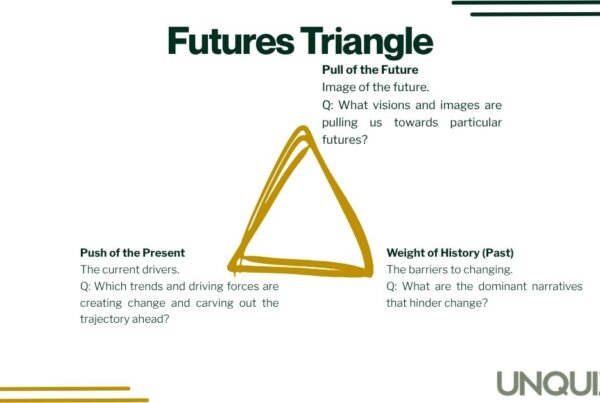
Strategic foresight helps organisations make better decisions without predicting the future as it tests strategy against multiple plausible futures so organisations can determine where they are exposed and where they have room to manoeuvre. Scenario planning, stress testing, and horizon scanning are especially useful because they make uncertainty visible before it becomes a crisis for the organisation. This approach is valuable as it make strategy more adaptive and reduces risks.
Organisational decision makers can build resilience by anticipating and preparing for situations through strategic foresight frameworks so that the organisation can adjust without losing coherence. More importantly, organisations should build decision systems that are robust under uncertainty and adaptive when uncertainty brings challenges.
A few questions to guide organisations could be:
- What are the controllables and uncontrollables in times of uncertainty?
- What signals should we monitor?
- What decisions increase our flexibility if the environment changes?
How to answer these questions?
At Unquiet ® Ltd, we can help you to determine where the uncertainties will arise from through strategic foresight frameworks.
Get in touch if you’d like to learn how we can guide you through this analysis.
Subscribe to the Unquiet newsletter to receive thoughtful reflections on strategy, foresight, leadership, and change, plus updates on new writing, events, and what’s coming next directly to your mailbox.